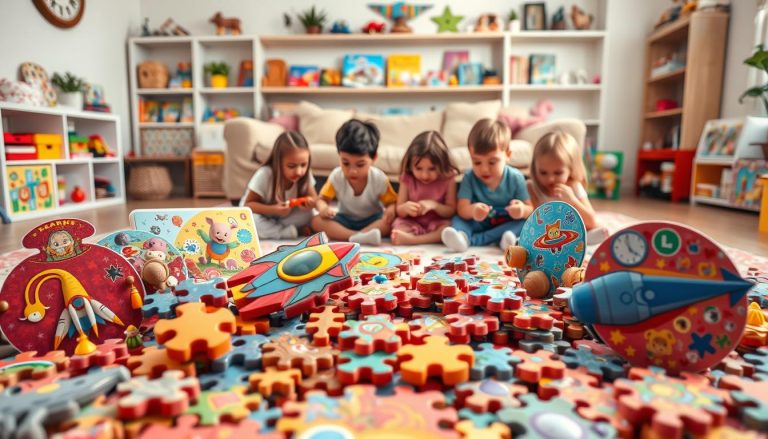
Engaging in Educational Puzzles is a fun and interactive way for young minds to develop essential skills. These activities not only entertain but also foster Cognitive Development by enhancing problem-solving abilities and logical thinking.
Puzzle games designed for kids are more than just entertainment; they play a significant role in shaping young minds. By incorporating Kids Puzzle Games into their daily routine, children can improve their critical thinking and spatial awareness.
Key Takeaways
- Enhance problem-solving skills through interactive puzzles.
- Foster cognitive development with engaging games.
- Improve critical thinking and spatial awareness.
- Make learning fun with educational puzzle games.
- Support overall development with puzzle activities.
The Power of Puzzles in Child Development
Engaging in puzzle play is a powerful way to boost cognitive development in children. Puzzles offer a fun and challenging way for kids to develop essential skills that benefit them throughout their lives.
Cognitive Benefits of Puzzle Play
Puzzle play enhances problem-solving skills and critical thinking in children. By working on puzzles, kids learn to analyze information, identify patterns, and develop strategies to overcome obstacles. This cognitive development is crucial for academic success and real-life problem-solving.
Social and Emotional Growth Through Puzzles
Puzzles also contribute to social and emotional growth in children. Working on puzzles helps kids develop patience and persistence as they learn to overcome challenges. Additionally, puzzles can be a collaborative activity, promoting teamwork and communication among children.
By incorporating puzzles into their play, children can experience significant cognitive, social, and emotional benefits. This makes puzzles an invaluable tool in child development.
Popular Kids Puzzle Games for Different Learning Styles
Kids puzzle games come in various forms, catering to different learning styles and cognitive needs. This diversity ensures that every child can find a puzzle that suits their unique way of learning and developing problem-solving skills.
Jigsaw Puzzles and Shape Sorters
Jigsaw puzzles and shape sorters are classic puzzle types that help develop spatial awareness and fine motor skills. Jigsaw puzzles require children to fit pieces together to form a complete picture, enhancing their understanding of spatial relationships. Shape sorters, on the other hand, teach children to differentiate between various shapes and fit them into corresponding slots.
Logic Games and Brain Teasers
Logic games and brain teasers are designed to challenge a child’s thinking and problem-solving abilities. These puzzles often require children to think critically and make connections between seemingly unrelated concepts. They are excellent for developing cognitive skills and preparing children for more complex challenges.
Word and Language Puzzles
Word and language puzzles focus on developing linguistic skills and vocabulary. These puzzles can range from simple word searches to more complex crosswords and anagrams. They help improve a child’s understanding of language and enhance their communication skills.
Pattern and Sequence Games
Pattern and sequence games are crucial for developing a child’s ability to recognize and predict patterns. These games involve identifying sequences of shapes, colors, or numbers and continuing them. They are essential for building mathematical skills and logical reasoning.
| Puzzle Type | Learning Style | Skills Developed |
|---|---|---|
| Jigsaw Puzzles | Visual-Spatial | Spatial awareness, Fine motor skills |
| Logic Games | Logical-Sequential | Problem-solving, Critical thinking |
| Word Puzzles | Linguistic | Vocabulary, Communication skills |
| Pattern Games | Logical-Sequential | Pattern recognition, Mathematical skills |
Age-Appropriate Puzzle Recommendations
The key to unlocking your child’s puzzle-solving potential lies in selecting age-appropriate puzzles that cater to their developmental stage. Puzzles are not just a fun activity; they are a crucial tool for cognitive development, enhancing problem-solving skills, and fostering patience and persistence.
Puzzles for Toddlers (Ages 1-3)
For toddlers, puzzles should be simple, colorful, and made of durable materials. They should have large pieces that are easy to grasp and fit into corresponding slots. These early puzzles help develop fine motor skills and hand-eye coordination.
Examples include shape sorters and simple jigsaw puzzles with a few large pieces. Brands like Melissa & Doug offer high-quality puzzles designed for this age group.
Preschool Puzzle Games (Ages 3-5)
Preschoolers can handle more complex puzzles with smaller pieces. At this stage, puzzles can introduce basic concepts like numbers, letters, and simple patterns. Puzzles with 12-24 pieces are ideal for this age group.
These puzzles not only enhance problem-solving skills but also encourage learning through play. Look for puzzles that are both fun and educational, such as those featuring popular children’s characters.
Elementary School Puzzles (Ages 6-10)
Children in this age group can tackle more challenging puzzles with 50-100 pieces or more. They can handle complex themes and more intricate designs. Jigsaw puzzles, word searches, and logic puzzles are excellent choices.
These puzzles help improve critical thinking and problem-solving skills. They also promote patience and persistence as children work to complete the puzzle.
Challenging Puzzles for Older Kids (Ages 10+)
Older kids can enjoy highly complex puzzles, including 3D puzzles, jigsaw puzzles with over 500 pieces, and sophisticated logic games. These puzzles challenge their cognitive abilities and provide a sense of accomplishment upon completion.
| Age Group | Puzzle Type | Number of Pieces |
|---|---|---|
| 1-3 | Simple Jigsaw, Shape Sorters | 2-6 |
| 3-5 | Jigsaw Puzzles, Simple Patterns | 12-24 |
| 6-10 | Jigsaw Puzzles, Word Searches, Logic Puzzles | 50-100+ |
| 10+ | 3D Puzzles, Complex Jigsaw, Logic Games | 500+ |
By selecting puzzles that match your child’s age and skill level, you can ensure they derive maximum benefit from puzzle play while having fun. This approach supports their cognitive development and fosters a lifelong love for problem-solving.
Educational Benefits of Regular Puzzle Play
The educational benefits of puzzle play are multifaceted, contributing to the development of critical thinking, persistence, and hand-eye coordination. Engaging in puzzle activities regularly can significantly enhance a child’s cognitive abilities and motor skills, preparing them for future academic challenges.
Problem-Solving and Critical Thinking
Puzzle play is instrumental in developing problem-solving skills and critical thinking. As children work through puzzles, they learn to analyze pieces, understand spatial relationships, and make informed decisions about how pieces fit together. This process enhances their ability to approach problems methodically and think critically about solutions.
Patience and Persistence Building
Puzzles require patience and persistence, qualities that are essential for academic success. By working on puzzles, children develop these traits as they learn to overcome obstacles and stay focused on a task until completion. This persistence is a valuable skill that benefits many areas of life.
Fine Motor Skills and Hand-Eye Coordination
Puzzle play also contributes to the development of fine motor skills and hand-eye coordination. As children manipulate puzzle pieces, they improve their dexterity and coordination, skills that are crucial for writing, drawing, and other academic activities.
Memory and Attention Span Improvement
In addition to the aforementioned benefits, regular puzzle play can improve a child’s memory and attention span. By remembering the shapes and colors of puzzle pieces and focusing on the task at hand, children enhance their ability to concentrate and recall information. This improvement in memory and attention span can have a positive impact on their academic performance.
Choosing the Right Kids Puzzle Games
With so many puzzle games available, choosing the right one for your child requires careful consideration of several factors. The key to making the right choice lies in understanding your child’s unique needs and preferences.
Matching Puzzles to Your Child’s Interests
One of the most critical factors in selecting a puzzle game is ensuring it aligns with your child’s interests. When a puzzle reflects a child’s favorite theme or character, it enhances their engagement and motivation to solve it. For instance, if your child loves animals, an animal-themed jigsaw puzzle can be an excellent choice.
Considering Skill Level and Challenge
It’s essential to choose puzzles that match your child’s skill level. A puzzle that is too easy may bore them, while one that is too difficult can lead to frustration. Look for puzzles with adjustable difficulty levels or those that offer a gradual increase in complexity as your child progresses.
Quality and Durability Factors
When selecting puzzle games, the quality and durability of the product are crucial. Quality puzzles are made from sturdy materials that can withstand repeated use, ensuring they remain a valuable resource for your child’s development over time. Consider puzzles with well-cut pieces and robust construction.
By considering these factors, you can make an informed decision when choosing puzzles that are both fun and beneficial for your child’s cognitive and emotional growth.
Digital vs. Physical Puzzle Options
When it comes to puzzle games for kids, parents often face a dilemma: should they opt for digital puzzle apps or traditional physical puzzles? Both options have their merits, and the best choice depends on a child’s individual needs and preferences.
Benefits of Traditional Hands-On Puzzles
Physical puzzles offer several benefits, including:
- Developing Fine Motor Skills: Handling puzzle pieces helps children develop their fine motor skills and hand-eye coordination.
- Enhancing Problem-Solving: Physical puzzles encourage children to think critically and develop problem-solving strategies.
- Promoting Social Interaction: Working on physical puzzles can be a collaborative activity, fostering social interaction and teamwork.
Advantages of Digital Puzzle Apps
Digital puzzle apps have their own set of advantages, including:
- Convenience and Accessibility: Digital puzzles are easily accessible on smartphones and tablets, making them perfect for on-the-go entertainment.
- Personalized Experience: Many digital puzzle apps offer adjustable difficulty levels and personalized feedback, catering to a child’s individual needs.
- Engaging Animations and Sounds: Digital puzzles often feature engaging animations and sounds, making the puzzle-solving experience more enjoyable and interactive.
Creating a Balanced Puzzle Collection
To provide a well-rounded puzzle experience, consider creating a balanced collection that includes both physical and digital puzzle options. This approach allows children to enjoy the benefits of both formats and keeps puzzle time fresh and exciting.
By combining traditional hands-on puzzles with digital puzzle apps, parents can cater to their child’s diverse needs and preferences, ensuring a fun and engaging puzzle experience.
Conclusion
Incorporating a variety of Kids Puzzle Games into a child’s playtime can significantly enhance their Cognitive Development. These games not only provide entertainment but also offer numerous Educational Benefits that are essential for a child’s growth.
By choosing the right puzzle games, parents can help their children develop problem-solving skills, hand-eye coordination, and critical thinking. Whether it’s through traditional hands-on puzzles or digital puzzle apps, the key is to create a balanced puzzle collection that caters to a child’s diverse learning needs.
As children engage with different types of puzzles, they experience Educational Benefits that extend beyond the classroom, fostering a love for learning and a strong foundation for future academic success. Encourage your child to explore the world of Kids Puzzle Games and watch them grow and develop through play.
FAQ
What are the benefits of puzzle games for kids?
Puzzle games enhance problem-solving skills, critical thinking, patience, and persistence, while also promoting social and emotional growth, fine motor skills, and hand-eye coordination.
What type of puzzles are suitable for toddlers aged 1-3?
For toddlers, simple shape sorters, and soft jigsaw puzzles with large pieces are ideal, as they introduce basic problem-solving skills and hand-eye coordination.
Are digital puzzle apps as effective as traditional puzzles?
Both digital and traditional puzzles have their benefits. Digital puzzle apps offer interactive and adjustable challenges, while traditional puzzles promote hands-on learning and fine motor skills. A balanced mix of both is recommended.
How do I choose the right puzzle for my child?
Consider your child’s interests, skill level, and age when selecting a puzzle. For example, if they enjoy animals, choose animal-themed puzzles. Ensure the puzzle’s complexity matches their skill level to keep them engaged.
Can puzzle games really improve my child’s memory and attention span?
Yes, regular puzzle play can enhance memory and attention span by challenging the brain and promoting cognitive development. Puzzles require children to remember shapes, colors, and patterns, which can improve memory.
What are some popular kids puzzle games for different learning styles?
Popular options include jigsaw puzzles, shape sorters, logic games, word puzzles, and pattern games, catering to different cognitive and learning needs, such as visual-spatial skills or language development.
How often should my child play with puzzles?
Encourage regular puzzle play, ideally a few times a week, to see consistent cognitive and educational benefits. The frequency can vary based on your child’s interest and age.